According to the "Lonely Planet" guide to Vietnam, "there is no conceivable reason to go to Dong Ha." I beg to differ. We're staying here for a week, and we're off to a great start.
Between a full schedule and limited Internet access it's been impossible to make any posts for a couple of days. With any luck I'll find somewhere to load photos to post tomorrow. I hope so, because one picture will save me about 1,000 words - and I suspect this entry will be five or six pictures' worth!
It's Wednesday afternoon here. Early Monday morning we said good-bye to Hoi An. We left town just as kids were heading to school, so the streets were full of bicycles: we passed hundreds of girls in their white ao dais (a graceful tunic-and-trouser outfit) and boys in their blue pants, white shirts and red bandanas, all walking and peddling to school.
Our route took us through Da Nang, then out for a brief tourism detour to My Son to see the Champa kingdom ruins there. Dating from about 750-1300, the brick ruins are nestled in a jungled valley. Looking at the ancient carvings, sculptures and temple buildings brought to mind a favorite quote from a Carl Sandberg poem: "We are the greatest people, the greatest nation. Nothing like us ever was." If only the bricks could speak.
We crossed Hai Van Pass, lunched at Lang Co, stretched our legs with a walk on the beach, then settled back in for the three hour trip to Dong Ha. We got here at about 5:15 and had just enough time to get cleaned up for our welcome dinner, where we met our hosts from the Quang Tri Province Department of Foreign Affairs (DoFA) and the rest of the PeaceTrees in-country staff, Miss Ha and Miss Hang. We were also joined by two short-term travelers who will share our activities in Dong Ha, one of whom is my good friend Bill Groth. It's great to have him here, especially to share in the Kindergarten dedication.
On Tuesday - yesterday - our work began. First up was a visit to Friendship Village, a community of 100 homes built by PeaceTrees on the former US Marine Corps base at Dong Ha. We traded songs with the kindergarteners there: they performed traditional songs for us, then we reciprocated with "The Itsy-Bitsy Spider," "If You're Happy and You Know It," and "I'm a Little Teapot." (By the way, when it came to dances and hand gestures, the Kindergarteners had it over us by a long shot. That itsy-bitsy spider thing isn't as easy as it looks.) We had a great time with the kids - we brought toys, took pictures, asked them their names, and thought about packing them up and taking them home with us. SO cute, and utterly charming.
I had brought along copies of photos I'd taken on my last trip; I had a group shot with about ten kids, and had enough prints made for all of them.
One of the village girls was in charge of delivering the photos to the right people, and apparently she was successful: just as we were getting ready to get on the bus, a grandmother with a conical hat and big, broad smile came running up to me, grabbed me by the hand, and ran with me down to her home. There was one of the girls from the picture -- her granddaughter, I think. How wonderful to see her again and snap another photo to share, and to see her house. Like many of the homes we've seen it's very simple: three rooms, concrete, minimal furnishing, and at least four people live there. But there is electricity and water and a kitchen garden - and a big improvement from the homes that were there before.
Just before leaving Friendship Village we stopped to look at the trees I'd planted there two years ago. These were special trees -- memorial trees planted on behalf of my friends, and also one that Chuck and I planted for my brother David. In two years they've grown from three-foot-high seedlings to 12-15 foot trees. What a wonderful feeling to see them thriving.
We spent the afternoon visiting the Danaan Perry Landmine Education Center, first visiting with some of the young landmine and UXO victims who have been assisted by PeaceTrees, then planting new seedlings. Two thousand trees later we were muddy, tired, and happy: we know that in just a year or two, these new trees will be tall and strong, providing shade and enriching the air and soil.
Today was also a tree-planting day, but it was less achievement oriented and more relationship oriented. We planted at a local high school; the grounds there were cleared of UXO by PeaceTrees deminers. The kids were excited, nervous, and shy - for many, we were the first foreigners they'd ever met. We joined the English class and sat at the benches with the kids while the teacher gave a short lesson (not entirely sure what it was about -- let's just say that pronunciation wasn't his strong suit). Next we planted together. I had a group of about ten girls, all 16 years old, who joined me in the sticky red mud to plant, stake and tie the trees. We had little language, but much laughter and lots of great big smiles all around. We washed up in the cement courtyard of a restaurant across the street - the girls and I took turns pulling up the water from the well and a fellow traveler scrubbed shoes. It's five hours later and my shoes and socks are still soaked.
Last stop: a resettlement camp. Flooding last year displaced about 100 families. A German NGO has built homes for them in a nearby village; PeaceTrees is doing the UXO removal and environmental restoration. It was a full-fledged community event, with the assistant mayor, many local villagers, and even a few stray cows joining us in planting 100 trees.
They'll provide shade around a sports field that will be built there in the near future.
Tomorrow is the kindergarten dedication in A Xing. I can't wait. We stopped at the market to get a few classroom supplies -- mats for the floor (the children can use them for seating or naps), a nice big wall clock, and a CD-cassette player. We'll be sharing music with the kids tomorrow and hopefully capturing a few of their tunes to bring back. I look forward to celebrating with the community, seeing the children, and planting a small grove of memorial trees. Ready, set, grow!
21 March 2007


18 March 2007
Laying the Groundwork
Inch by lovely inch we're making our way inch up the "S" of Vietnam.
I so appreciate having a couple of days to get the flavor of the place before diving into our work in Quang Tri Province. Quang Tri will be a rich experience for many reasons, but not because of its natural beauty or its architecture, as it was essentially deforested and levelled during the war. For that reason I'm especially glad that we're starting our trip with visits to areas of natural, architectural and historical significance. I think it will provide a helpful frame of reference for better understanding Quang Tri.
Today we took the 6:00 a.m. flight from Saigon to Da Nang, where we were joined by in-country PeaceTrees staff members Miss Ha and Miss Hang. We made only a brief stop in Da Nang -- to purchase electric keyboards ("organs") for two schools, including the Warner Kindergarten. Teachers in Vietnam are required to learn basic keyboard skills in order to lead the children in music lessons, so the organs will be put to very good use.
We're overnighting in the beautiful town of Hoi An. For those who have been to Belgium, Hoi An is a kind of Vietnamese Bruges -- a former major port and trade-route town that had its waterway fill with silt, essentially freezing it in time. It is rich with 200-year-old Japanese and Chinese-influenced architecture and has a lively and thriving marketplace; I spent the day feeling as though I were walking through one big post card.
Tourism is flourishing in Hoi An; there are many more foreigners here than I remember seeing two years ago. Shops are abundant and vendors are often insistent, but the town is vibrant and beautiful nonetheless. People have been welcoming and eager to talk. Our 20-year-old lunch waitress joined us at the table and giggled uncontrollably when my fried spring roll exploded into rice noodle confetti. Old women with betel nut-blackened teeth grinned broadly when I smiled at them, and teenagers sharing a streetside snack of miniature sea snails invited me to sample a bite. Laughter is easy to share (and easy to cause, but that's OK, too).
I'll drift off to sleep tonight (hopefully not in my rice bowl) with Hoi An playing like a beautiful slide show in my head, grateful for today's adventure and eager to head to Quang Tri where we'll step out of tourism and into real life.
I so appreciate having a couple of days to get the flavor of the place before diving into our work in Quang Tri Province. Quang Tri will be a rich experience for many reasons, but not because of its natural beauty or its architecture, as it was essentially deforested and levelled during the war. For that reason I'm especially glad that we're starting our trip with visits to areas of natural, architectural and historical significance. I think it will provide a helpful frame of reference for better understanding Quang Tri.
Today we took the 6:00 a.m. flight from Saigon to Da Nang, where we were joined by in-country PeaceTrees staff members Miss Ha and Miss Hang. We made only a brief stop in Da Nang -- to purchase electric keyboards ("organs") for two schools, including the Warner Kindergarten. Teachers in Vietnam are required to learn basic keyboard skills in order to lead the children in music lessons, so the organs will be put to very good use.
We're overnighting in the beautiful town of Hoi An. For those who have been to Belgium, Hoi An is a kind of Vietnamese Bruges -- a former major port and trade-route town that had its waterway fill with silt, essentially freezing it in time. It is rich with 200-year-old Japanese and Chinese-influenced architecture and has a lively and thriving marketplace; I spent the day feeling as though I were walking through one big post card.
Tourism is flourishing in Hoi An; there are many more foreigners here than I remember seeing two years ago. Shops are abundant and vendors are often insistent, but the town is vibrant and beautiful nonetheless. People have been welcoming and eager to talk. Our 20-year-old lunch waitress joined us at the table and giggled uncontrollably when my fried spring roll exploded into rice noodle confetti. Old women with betel nut-blackened teeth grinned broadly when I smiled at them, and teenagers sharing a streetside snack of miniature sea snails invited me to sample a bite. Laughter is easy to share (and easy to cause, but that's OK, too).
I'll drift off to sleep tonight (hopefully not in my rice bowl) with Hoi An playing like a beautiful slide show in my head, grateful for today's adventure and eager to head to Quang Tri where we'll step out of tourism and into real life.
17 March 2007
Southern Hospitality
Still have a case of the jetlag woozies, so this will be brief. But what a couple of days!
Got into Saigon yesterday mid-morning and had a low-key, get-acclimatized day that mostly revolved around food. More about the culinary adventures in a later post. Lilac-colored soup and durian (a.k.a. the fruit that smells like old gym socks) ice cream deserve a page of their own.
Weather-wise we're enveloped in heat and humidity. Take a wet wool blanket, run it through the dryer on high heat for 15 minutes, then roll up in it like a spring roll and you've got a pretty good idea of what it's like. Thankfully, though, it is sunny: there's a regional draught that has been bad for agriculture, but great for visitors.
Exploring a slice of the Mekong Delta was today's agenda, and it was fabulous. We started in the town of My Tho, an hour's drive south of Saigon, where we boarded a boat and set out onto the 3-kilometer-wide Mekong river and made several island stops. Our "mini-tours" included fruit-tasting, a local music performance, a honeybee "farm," horse-cart travel, small boat travel, and a brilliant lunch-time feast at an unnamed restaurant that disappeared back into the greenery as we floated away. It almost felt as though we dreamed it.
Most striking for me was the travel through the palm- and mangrove-lined canals. We were on traditional boats -- long, narrow and wobbly -- being paddled and poled by local women (the boats, not us). We didn't speak; the stillness felt heavy in the humid air. Foliage formed a tunnel around us and spots of sunlight played on the water and reflected back, dancing on the greens above. The only sounds were insects, birds, and the soft splooshing of paddles in the brown water. There were abundant butterflies: large, iridescent black ones; small ones of orange and brown and yellow. I was impressed both by the beauty of the place and also by the maze of waterways. To my eye all the palm and mangrove trees look pretty much alike; it would be impossible for me to tell one waterway from another.
Tomorrow morning we'll depart the hotel at 4:00 a.m. and fly to DaNang at 6:00. I'm glad for today's brief chance to see the rural south. It will provide a point of contrast to other areas and help to paint a more complete picture of Vietnam.
A last note. While we were having our day on the Delta, one of our group members was having a very different experience. She lost her brother in the Vietnam War and today had the opportunity to visit the place where he gave his life. It was a healing journey for her, and she told me she left the spot feeling profoundly grateful for the opportunity to be there. From talking with some of the vets who are also with us, I think it's a healing journey for them as well. More than I realized, PeaceTrees is a fitting name. The first seeds that we're planting on this trip are seeds of healing and renewal in ourselves. I look forward to watching them grow.
Got into Saigon yesterday mid-morning and had a low-key, get-acclimatized day that mostly revolved around food. More about the culinary adventures in a later post. Lilac-colored soup and durian (a.k.a. the fruit that smells like old gym socks) ice cream deserve a page of their own.
Weather-wise we're enveloped in heat and humidity. Take a wet wool blanket, run it through the dryer on high heat for 15 minutes, then roll up in it like a spring roll and you've got a pretty good idea of what it's like. Thankfully, though, it is sunny: there's a regional draught that has been bad for agriculture, but great for visitors.
Exploring a slice of the Mekong Delta was today's agenda, and it was fabulous. We started in the town of My Tho, an hour's drive south of Saigon, where we boarded a boat and set out onto the 3-kilometer-wide Mekong river and made several island stops. Our "mini-tours" included fruit-tasting, a local music performance, a honeybee "farm," horse-cart travel, small boat travel, and a brilliant lunch-time feast at an unnamed restaurant that disappeared back into the greenery as we floated away. It almost felt as though we dreamed it.
Most striking for me was the travel through the palm- and mangrove-lined canals. We were on traditional boats -- long, narrow and wobbly -- being paddled and poled by local women (the boats, not us). We didn't speak; the stillness felt heavy in the humid air. Foliage formed a tunnel around us and spots of sunlight played on the water and reflected back, dancing on the greens above. The only sounds were insects, birds, and the soft splooshing of paddles in the brown water. There were abundant butterflies: large, iridescent black ones; small ones of orange and brown and yellow. I was impressed both by the beauty of the place and also by the maze of waterways. To my eye all the palm and mangrove trees look pretty much alike; it would be impossible for me to tell one waterway from another.
Tomorrow morning we'll depart the hotel at 4:00 a.m. and fly to DaNang at 6:00. I'm glad for today's brief chance to see the rural south. It will provide a point of contrast to other areas and help to paint a more complete picture of Vietnam.
A last note. While we were having our day on the Delta, one of our group members was having a very different experience. She lost her brother in the Vietnam War and today had the opportunity to visit the place where he gave his life. It was a healing journey for her, and she told me she left the spot feeling profoundly grateful for the opportunity to be there. From talking with some of the vets who are also with us, I think it's a healing journey for them as well. More than I realized, PeaceTrees is a fitting name. The first seeds that we're planting on this trip are seeds of healing and renewal in ourselves. I look forward to watching them grow.
15 March 2007
Changing Planes
I'm writing this somewhere over the Pacific Ocean, south of Tokyo and north of Yap. I like long flights: it feels like I'm suspended not just in air, but in time. There's a peculiar freedom to cocoon or contemplate, for which I am especially grateful tonight.
This trip is starting on an unexpected turn. Many reading this will already know that my mom, our much-loved and aptly-named Marvel Warner, passed away quietly on Sunday with close family in song by her side. Dad passed four months ago; my sister Marci and I delight in thinking they're dancing together again.
Last year, at age 82, Mom joined Toastmasters. Earlier this month she was working on writing her tenth speech. Marci shared it with me and I want to include an excerpt here.
"Have you ever felt lonely? Discouraged? Miserable? I have.
My mother's adage was 'Don't sit around feeling sorry for yourself! There's always someone that needs help more than you do. Help them instead!'
I really had to apply my mother's words when we got news of the loss of our son in Vietnam. It was inconceivable that he was gone. He had packed more living into his 21 years than most people do in 70. He had a real joie de vivre, and my husband and I determined that as a family we would maintain that joy and try to share it.
We had lived on an island - both literally and figuratively - but John Donne wrote, 'No man is an island... Any man's death diminishes me because I am involved in mankind.'
Now we began to reach out... there are so many ways we can help if we are not marooned on our own little islands of self-interest."
Mom was so excited about my involvement with PeaceTrees and the kindergaten project that we all agreed the best way to honor her would be to continue on the trip. An now I get to take her words to heart as I go in joy and with her blessing.
We flew north out of Sea-Tac Airport tonight then made a tight clockwise circle right above our old family home on Mercer Island. I think that in a sense, Mom, Dad and Dave are all traveling with me... they're just on a different plane.
This trip is starting on an unexpected turn. Many reading this will already know that my mom, our much-loved and aptly-named Marvel Warner, passed away quietly on Sunday with close family in song by her side. Dad passed four months ago; my sister Marci and I delight in thinking they're dancing together again.
Last year, at age 82, Mom joined Toastmasters. Earlier this month she was working on writing her tenth speech. Marci shared it with me and I want to include an excerpt here.
"Have you ever felt lonely? Discouraged? Miserable? I have.
My mother's adage was 'Don't sit around feeling sorry for yourself! There's always someone that needs help more than you do. Help them instead!'
I really had to apply my mother's words when we got news of the loss of our son in Vietnam. It was inconceivable that he was gone. He had packed more living into his 21 years than most people do in 70. He had a real joie de vivre, and my husband and I determined that as a family we would maintain that joy and try to share it.
We had lived on an island - both literally and figuratively - but John Donne wrote, 'No man is an island... Any man's death diminishes me because I am involved in mankind.'
Now we began to reach out... there are so many ways we can help if we are not marooned on our own little islands of self-interest."
Mom was so excited about my involvement with PeaceTrees and the kindergaten project that we all agreed the best way to honor her would be to continue on the trip. An now I get to take her words to heart as I go in joy and with her blessing.
We flew north out of Sea-Tac Airport tonight then made a tight clockwise circle right above our old family home on Mercer Island. I think that in a sense, Mom, Dad and Dave are all traveling with me... they're just on a different plane.
08 March 2007
Breaking the Language Barrier
Is there anything more humbling than trying to learn a foreign language? In my mother tongue I am a reasonably competent adult. I can use a full palette of words to express complex ideas, listen for nuance and paint verbal images. By contrast, in Vietnamese I can say "Here is the yellow butterfly," and even then, I'm probably mispronouncing it. Not exactly the stuff of great conversation.
I have now spent two weeks of quality time with the CD "Sing n' Learn Vietnamese." I walk around the house humming the tunes to "Who Do You Love" and "Mr. Toad." They're in my head when I wake up in the morning; I can even play them on the piano. But the words? Stubbornly, tenaciously, utterly elusive. They just won't stick.
Part of the challenge is that Vietnamese is a tonal language. There are six tones. To further complicate things, each word is only one syllable. So each syllable can be pronounced six different ways, and each one is a different word. "Mother," "horse," and "rice seedling" are dangerously similar (ma, ma, ma), and I'm sure there are other syllables that are even more hazardous. I'm afraid to think what could happen when I try to read something on a menu.
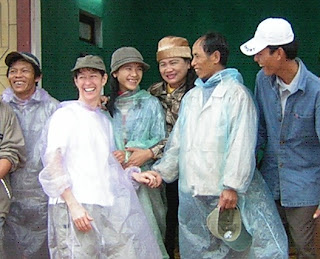 But - and I'm going to wax philosophical for a minute - it seems to me that language barriers, while they're frustrating at times, also offer the gift of a different kind of communication. Sometimes it's tempting to hide behind words. Instead of connecting us, they can keep us at arm's length. We use them to portray ourselves the way we want to be seen; we use them to keep the conversation superficial. By contrast "conversation" without a common language can strip away all of the veneers and allow people to meet at the most basic, real level. Instead of exchanging pleasantries, we can exchange looks and smiles. Instead of speaking with our words, we can speak with our hearts. That kind of communication is so rich.
I recently ran across a quote from Fred Rogers (yes, that Fred Rogers, from Mr. Rogers' Neighborhood) that sums it up beautifully: "The older I get, the more convinced I am that the space between people who are trying their best to understand each other is hallowed ground."
Perhaps sometimes our shortcomings are really just strengths in clown costumes. If that's the case, language-wise, I've got a whole circus traveling with me. And I think we're going to have a wonderful time.
I have now spent two weeks of quality time with the CD "Sing n' Learn Vietnamese." I walk around the house humming the tunes to "Who Do You Love" and "Mr. Toad." They're in my head when I wake up in the morning; I can even play them on the piano. But the words? Stubbornly, tenaciously, utterly elusive. They just won't stick.
Part of the challenge is that Vietnamese is a tonal language. There are six tones. To further complicate things, each word is only one syllable. So each syllable can be pronounced six different ways, and each one is a different word. "Mother," "horse," and "rice seedling" are dangerously similar (ma, ma, ma), and I'm sure there are other syllables that are even more hazardous. I'm afraid to think what could happen when I try to read something on a menu.
 But - and I'm going to wax philosophical for a minute - it seems to me that language barriers, while they're frustrating at times, also offer the gift of a different kind of communication. Sometimes it's tempting to hide behind words. Instead of connecting us, they can keep us at arm's length. We use them to portray ourselves the way we want to be seen; we use them to keep the conversation superficial. By contrast "conversation" without a common language can strip away all of the veneers and allow people to meet at the most basic, real level. Instead of exchanging pleasantries, we can exchange looks and smiles. Instead of speaking with our words, we can speak with our hearts. That kind of communication is so rich.
I recently ran across a quote from Fred Rogers (yes, that Fred Rogers, from Mr. Rogers' Neighborhood) that sums it up beautifully: "The older I get, the more convinced I am that the space between people who are trying their best to understand each other is hallowed ground."
Perhaps sometimes our shortcomings are really just strengths in clown costumes. If that's the case, language-wise, I've got a whole circus traveling with me. And I think we're going to have a wonderful time.
Community
This week as I've been finalizing my packing list and thinking through last-minute details, I keep coming back to one word: community. What is community? And what does it mean in the context of this trip?
Normally when I think of community I think of shared geography or common interests: my neighborhood, city, family, friends, church. But I'm starting to recognize that community is something bigger than any of those.
Community. Communication. Communion. They're all related, from a root that means "shared by all." As I make this trip, it strikes me that while I'm the one getting on the airplane, the experience is being shared by all -- not just during the two weeks that I'm in Vietnam, but also before and after.
My community includes those of you reading about the trip and those who have encouraged and supported it. It includes fellow travelers and the people we will meet in Dong Ha, Quang Tri and Hue. It includes other PeaceTrees partners and participants. It includes the children in Mrs. O'Donnell's Kindergarten class in Wenatchee, Washington, who have recorded songs for me to take and share. And it includes a group of Marines who served forty years ago, and a group of Vietnamese children who will probably be around forty years after I'm gone. In the words of Wendell Berry, "We clasp the hands of those that go before us and the hands of those who come after us."
So as I finalize my plans and packing lists, I'll be remembering that I'm just one member of a much bigger community - one that goes beyond borders and transcends time.
"There can be no vulnerability without risk; there can be no community without vulnerability; there can be no peace, and ultimately no life, without community." - M. Scott Peck
Normally when I think of community I think of shared geography or common interests: my neighborhood, city, family, friends, church. But I'm starting to recognize that community is something bigger than any of those.
Community. Communication. Communion. They're all related, from a root that means "shared by all." As I make this trip, it strikes me that while I'm the one getting on the airplane, the experience is being shared by all -- not just during the two weeks that I'm in Vietnam, but also before and after.
My community includes those of you reading about the trip and those who have encouraged and supported it. It includes fellow travelers and the people we will meet in Dong Ha, Quang Tri and Hue. It includes other PeaceTrees partners and participants. It includes the children in Mrs. O'Donnell's Kindergarten class in Wenatchee, Washington, who have recorded songs for me to take and share. And it includes a group of Marines who served forty years ago, and a group of Vietnamese children who will probably be around forty years after I'm gone. In the words of Wendell Berry, "We clasp the hands of those that go before us and the hands of those who come after us."
So as I finalize my plans and packing lists, I'll be remembering that I'm just one member of a much bigger community - one that goes beyond borders and transcends time.
"There can be no vulnerability without risk; there can be no community without vulnerability; there can be no peace, and ultimately no life, without community." - M. Scott Peck
01 March 2007
A Fence for Water Buffalo
PTVN has let me know that kindergarten fund contributions have exceeded the project cost. Good news? Absolutely! The facility itself was only the first need; now we can tend to the details.
First, a little more information on the school. The village of A Xing is comprised of seven hamlets. Each hamlet needs its own kindergarten, but they share a single, larger primary school. With the addition of the David Warner Kindergarten three of seven hamlets now have facilities for their pre-primary kids.
Following are excerpts from an email "interview" with PTVN's in-country representative, Quang Le (more aptly called Saint Quang Le... you'll be hearing more about him in the future).
SWB: Where will the children go to school once they've "graduated" from Kindergarten?
Quang Le: They will go to the primary school that is located nearby.
SWB: How many students are attending?
Quang Le: 35 children.
SWB: Do the children have to pay to attend the school?
Quang Le: No, it is free.
SWB: Will the building also be used for meetings and other community functions?
Quang Le: It depends. The local authority can borrow the kindergarten to use for other hamlet multi-purposes when the school is off (or not in the school days).
SWB: Has the school been furnished and equipped with needed supplies?
Quang Le: They still need some more, especially one organ (keyboard) to serve for the music time. The average organ will range from $50-$100 USD.
SWB: Is there a plan to maintain the facility?
Quang Le: No. It does need to be painted each year.
SWB: Are there any special items (classroom or playground equipment, etc.) they might need?
Quang Le: There are three main items that the kindergarten really needs:
- A kitchen (children have to go back to their home for lunch, because the kindergarten has no kitchen). There is a project proposal for building a kitchen for A Xing kindergarten. It costs $1000.00 USD.
- Playground. The kindergarten now has no playground. They hope to have something like slide, see-saw, wheel... and it costs $700.00 USD minimum.
 - Fence. Without fence, water buffaloes often go inside and damage the kindergarten.
A fence for water buffaloes? As Dorothy would say, "We're not in Kansas anymore."
Happily, the current Kindergarten fund surplus should go a long way toward meeting the needs identified by Quang Le. We hope to purchase and deliver the keyboard for the dedication ceremony on March 22. We should be able to approve the kitchen and fence... maybe even some playground equipment.
So thank you, one and all. In with the lunches, out with the water buffalo!
First, a little more information on the school. The village of A Xing is comprised of seven hamlets. Each hamlet needs its own kindergarten, but they share a single, larger primary school. With the addition of the David Warner Kindergarten three of seven hamlets now have facilities for their pre-primary kids.
Following are excerpts from an email "interview" with PTVN's in-country representative, Quang Le (more aptly called Saint Quang Le... you'll be hearing more about him in the future).
SWB: Where will the children go to school once they've "graduated" from Kindergarten?
Quang Le: They will go to the primary school that is located nearby.
SWB: How many students are attending?
Quang Le: 35 children.
SWB: Do the children have to pay to attend the school?
Quang Le: No, it is free.
SWB: Will the building also be used for meetings and other community functions?
Quang Le: It depends. The local authority can borrow the kindergarten to use for other hamlet multi-purposes when the school is off (or not in the school days).
SWB: Has the school been furnished and equipped with needed supplies?
Quang Le: They still need some more, especially one organ (keyboard) to serve for the music time. The average organ will range from $50-$100 USD.
SWB: Is there a plan to maintain the facility?
Quang Le: No. It does need to be painted each year.
SWB: Are there any special items (classroom or playground equipment, etc.) they might need?
Quang Le: There are three main items that the kindergarten really needs:
- A kitchen (children have to go back to their home for lunch, because the kindergarten has no kitchen). There is a project proposal for building a kitchen for A Xing kindergarten. It costs $1000.00 USD.
- Playground. The kindergarten now has no playground. They hope to have something like slide, see-saw, wheel... and it costs $700.00 USD minimum.
 - Fence. Without fence, water buffaloes often go inside and damage the kindergarten.
A fence for water buffaloes? As Dorothy would say, "We're not in Kansas anymore."
Happily, the current Kindergarten fund surplus should go a long way toward meeting the needs identified by Quang Le. We hope to purchase and deliver the keyboard for the dedication ceremony on March 22. We should be able to approve the kitchen and fence... maybe even some playground equipment.
So thank you, one and all. In with the lunches, out with the water buffalo!
Subscribe to:
Posts (Atom)


